
Co-financing for renewable energy projects that contribute to society
JBIC’s Seven Selected “Global South” Projects
A credit line was signed in the Republic of Benin, a West African country with a low domestic electrification rate. This was the first Global Environmental Conservation Operations project in Africa, and it proved to be a significant project that met the needs of the host country to resolve social issues. We spoke to Satoko Fukaya and Hitomi Hirado, who were involved in the project, about its significance and background.
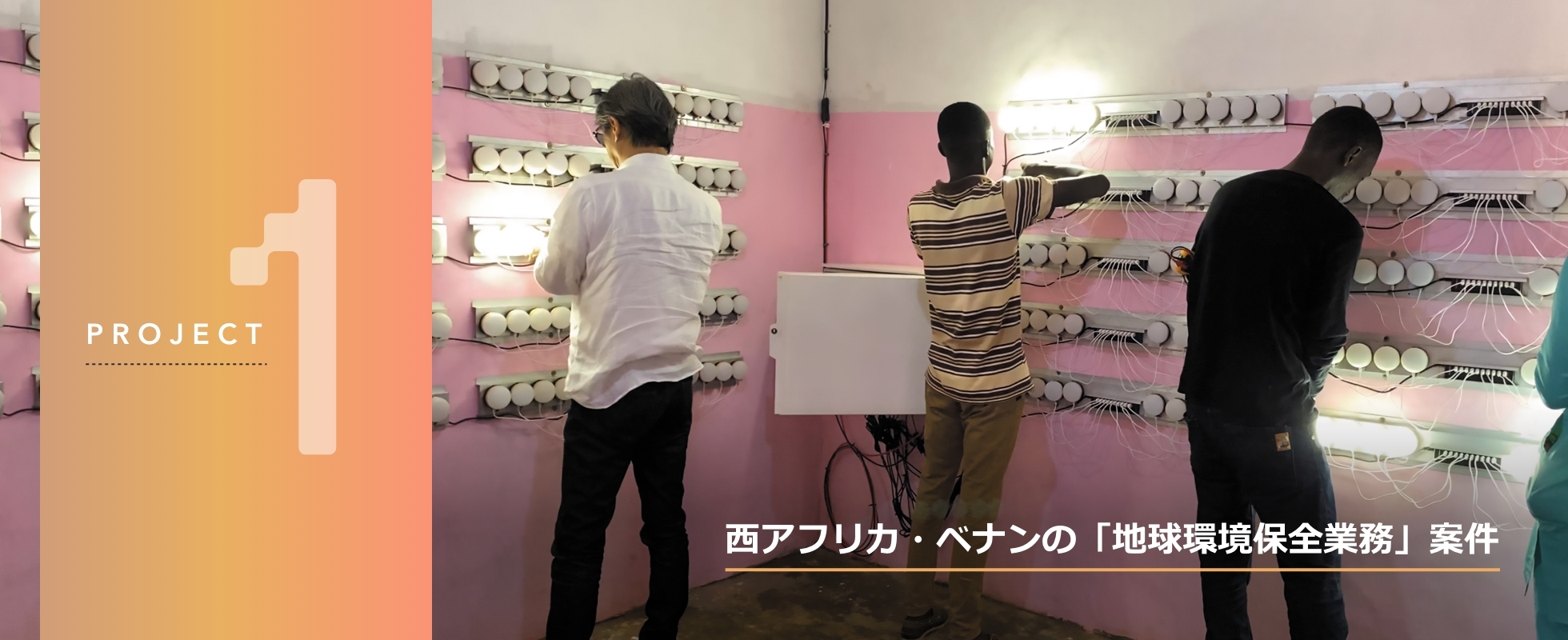
A lantern charging device connected to solar panels installed on the school roof
Co-financing for two renewable energy projects launched in response to TICAD7
The Republic of Benin, located in the western part of the African continent, imports fossil fuels and electricity from neighboring countries such as Nigeria. The country’s domestic electrification rate is low at around 40%, and its electricity self-sufficiency rate is only around 10%. In its national development plan, the government of Benin has set a goal of starting operation of solar power plants with a total capacity of 150MW by 2026. In
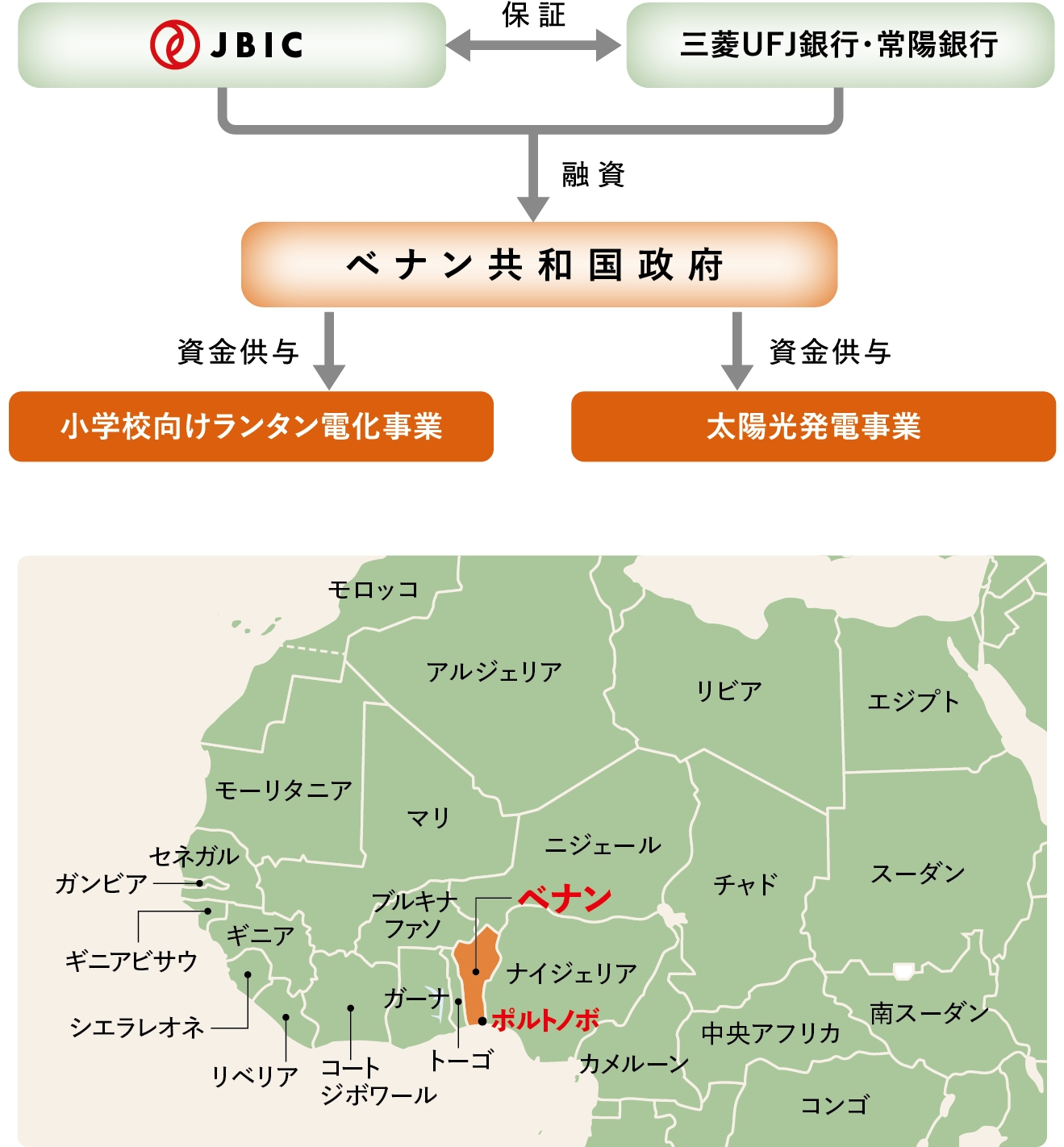
June 2023, JBIC decided to provide co-financing for two projects with the Benin government: 29 million euros for a solar power generation project and 1 million euros for a lantern electrification project. This was the first project with an African government under the Global Environmental Protection Operations (commonly known as “GREEN”) program, and the first project with Benin for JBIC. What was the background to this?
“Although we had received several offers from trading companies regarding loans to Benin, nothing had materialized until now. However, we recognized that Benin’s political and economic situation is more stable than other African countries, and that it has great potential. A high-level meeting with President Talon at TICAD 7 (the 7th Tokyo International Conference on African Development) held in Yokohama in 2019 served as the catalyst for our efforts to build a relationship with the Benin government, which we had been working on for several years, to finally come to fruition,” explains Satoko Fukaya, head of Unit 3 of JBIC’s Energy Solutions Department.
Even so, the decision to co-finance was not without its twists and turns.
JBIC signed a credit line with the Benin government in March 2021, but due to differences in time zones and business practices, discussions on individual projects had not progressed. Despite numerous letters and messages sent to Benin’s Minister of Economy and Finance, Waddani, pleading for even just one meeting, there was no response. Recognizing that progress could only be made on the ground, Hitomi Hirado, then a member of the Energy Solutions Department, accompanied the then-director to Benin.
Then, by chance, they bumped into the Minister of Economy and Finance on the plane to Benin. Hirado and his team were able to meet with the Minister in a corner of the plane, and the door to the project immediately opened. During their meeting on the plane and a subsequent meeting on site, it became clear that the Benin government had other projects in need of funding besides the originally planned project of electrifying lanterns for elementary schools.
By speaking directly with the Minister, I became aware of local needs and concerns.
The loan for this solar power generation project will install a new 25MW solar power generation facility and two substations on the site of a 50MW solar power generation facility, one of the largest in Benin. “By expanding the supply of electricity based on clean energy, we hope to contribute to promoting the adoption of renewable energy in Benin and improving the distorted energy structure that relies on fossil fuels in other countries,” says Hirado.
The elementary school electrification project involves installing solar panels on the roofs of elementary schools in unelectrified areas and lending lanterns charged with solar power to students, thereby achieving household electrification. This project is being promoted by the Japanese general incorporated association GOOD ON ROOFS, and the government was consulted about expanding it to Benin, which led to the signing of a credit line for this project.
“However, after speaking with the Minister, I realized that there was a need for solar power generation in addition to the lantern project,” says Fukaya. The Minister also expressed concerns about the sustainability of the lantern project. “They pointed out that the lanterns provided to the children might get stolen, break down, or be sold to obtain daily food.” While it is important to
adjust loan applications by determining what those seeking financing are looking for, it is also important not to forget the social contribution aspect of the lantern project, which aims to increase the number of children who can attend elementary school. “In Good on Roofs’ project, the lanterns that children take home not only brighten up their homes, but also charge their parents’ mobile phones, which encourages parents to send their children to school,” says Hirado.
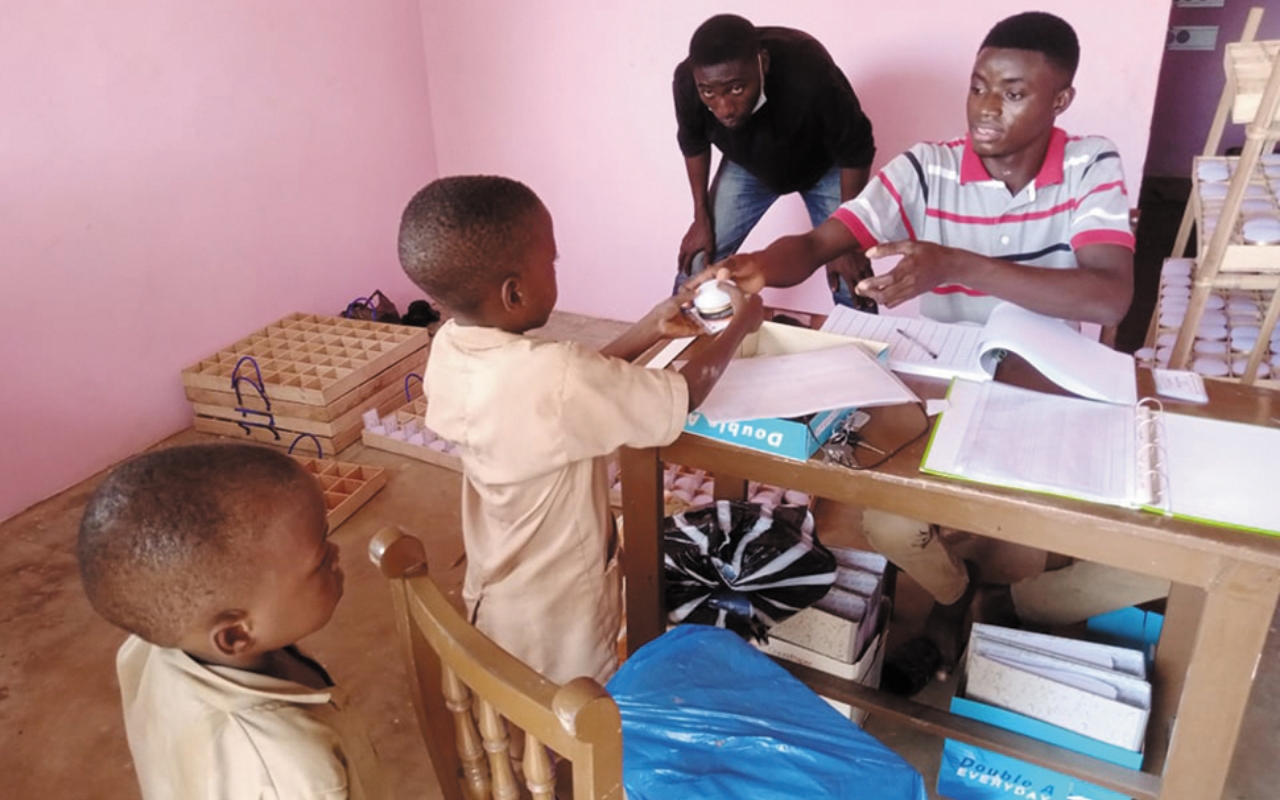
Receiving a lantern from an elementary school student
I realized the potential for social contribution through finance.
This project is smaller than the loans to African countries that the Energy Solutions Department has previously handled. Still, with growing interest in ESG investment and a trend toward promoting socially significant projects such as environmental conservation and education, “JBIC also recognized this potential,” says Fukaya.
It also marks a small but important step in terms of economic cooperation between Japan and the Global South. JBIC’s support for the Global South places emphasis on carbon neutrality and resolving social issues in the host country, emphasizing a stance of tailoring its response to the circumstances of each country. Furthermore,
Hirado, who was in charge of the project on-site, proudly states, “The recipient government’s commitment is evident in the fact that we chose a loan rather than aid or yen loans. Being able to exchange opinions on an equal footing will surely be beneficial for building future relationships.”
Social contribution efforts through finance are sure to be a key to connecting Japan and the Global South. JBIC will continue to accelerate its meticulous support.
Sources: https://www.jbic.go.jp/ja/information/today/today_2025sp/jtd_202502_sp3.html